


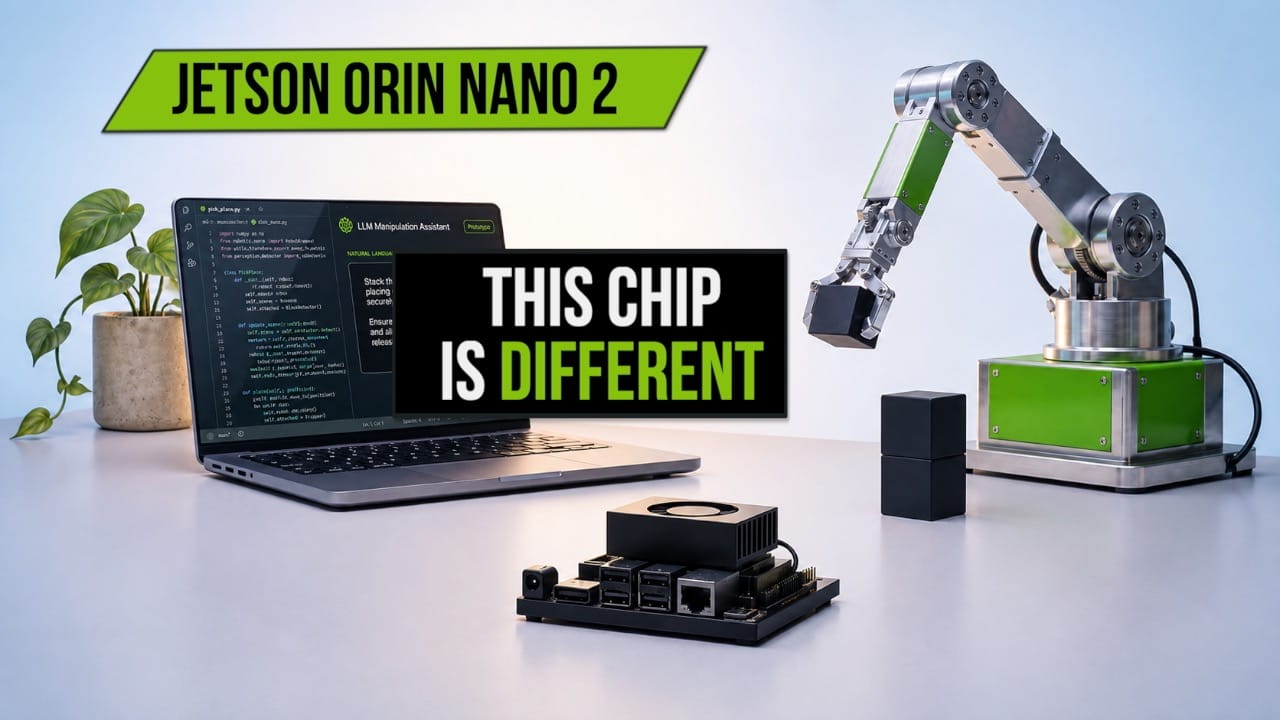
NVIDIA recently announced the Jetson Orin Nano 2, a successor to the popular Jetson Orin Nano Super. While the Orin Nano 2 won’t being shipping until the first half of 2027, NVIDIA did publish some good information on how the new chip performs. At what first appear as modest spec changes, it’s surprising that they were claiming a 2X inference improvement. Here’s a breakdown how that can be true. Looky here:

Since the video was published, we’ve been able to get some more information about the new system. Look at this the table of specs comparing different generations:
Jetson Orin Spec Comparison
| Orin Nano 4GB | Orin Nano 8GB | Orin Nano 2 8GB | Orin NX 8GB | Orin NX 16GB | |
|---|---|---|---|---|---|
| AI performance | 34 TOPS (INT8) | 67 TOPS (INT8) | 78 TOPS (INT8) | 117 TOPS (INT8) | 157 TOPS (INT8) |
| GPU | Ampere 512 CUDA Cores |
Ampere 1024 CUDA Cores |
Ampere 1536 CUDA Cores |
Ampere 512 CUDA Cores |
Ampere 1024 CUDA Cores |
| CPU | 6-core Cortex-A78 | 6-core Cortex-A78 | 8-core Cortex-A78 | 6-core Cortex-A78 | 8-core Cortex-A78 |
| Memory |
4 GB LPDDR5 51 GB/s |
8 GB LPDDR5 102 GB/s |
8 GB LPDDR5X 120 GB/s |
8 GB LPDDR5 102 GB/s |
16 GB LPDDR5 102 GB/s |
| PCIe |
1 ×4 + 3 ×1 PCIe Gen3 Root Port & Endpoint |
1 ×4 + 3 ×1 PCIe Gen3 Root Port & Endpoint |
1 ×4 + 2 ×1 PCIe Gen4 Root Port & Endpoint |
1 ×4 + 3 ×1 PCIe Gen4 Root Port & Endpoint |
1 ×4 + 3 ×1 PCIe Gen4 Root Port & Endpoint |
| Encode |
1080p30 supported by 1–2 CPU cores |
1080p30 supported by 1–2 CPU cores |
1× 4K60 (H.264) 2× 4K30 (H.264) 4× 1080p60 (H.264) 8× 1080p30 (H.264) |
1× 4K60 (H.265) 3× 4K30 (H.265) 6× 1080p60 (H.265) 12× 1080p30 (H.265) |
1× 4K60 (H.265) 3× 4K30 (H.265) 6× 1080p60 (H.265) 12× 1080p30 (H.265) |
| Power | 25 W | 25 W | 40 W | 40 W | 40 W |
| Mechanical | 69.6 mm × 45 mm 260-pin connector |
69.6 mm × 45 mm 260-pin connector |
69.6 mm × 45 mm 260-pin connector |
69.6 mm × 45 mm 260-pin connector |
69.6 mm × 45 mm 260-pin connector |
The table does a good job of explaining the differences between the products. There are several important changes to notice. First, the Orin Nano 2 switches to LPDDR5X memory, and you can see the bump in speed from the previous 102 GB/s to 120 GB/s. This is realized in better inference performance in token generation, a task which tends to be memory bound.
Second, on the compute side you can see that the number of CUDA cores increases to 1536, quite a jump from the previous 1024. In addition there are two more CPU cores.
Third, you can see that the Orin Nano 2 will be using PCIe Gen4, which means that you will be after to use faster NVME SSDs and data gathering devices with it than the Orin Nano Super. Finally, there is the inclusion of hardware video encoders, a feature that many developers have been asking for.
More Power, More Efficient
NVIDIA also states that the Orin Nano 2 performs the same inferencing tasks using 15W that the Orin Nano Super does using 25W. This in part can be attributed to using the next generation LPDDR5X memory. Also, the amount of power that the module can handle has been increased to 40W, similar to the Orin NX. It’s the tradeoff us developers love; less power same performance or more power, 2x inference performance.
Is It A Nintendo Switch 2 Chip?
When you look at the specs, it seems extremely similar to what we know about the Switch 2. However, one thing to remember is that the Jetson family of chips use a different CPU complex, based on the Cortex-A78AE. ARM uses the AE designation for automotive, which is more a catch all phrase these days for automotive and robotics. The Switch 2 uses a Cortex-A78C variant, which is shorthand for consumer.
We see this difference across the entire Jetson line, this is what separates Thor from DGX Spark for example. The Jetson cores are designed to be deterministic, given a task they attempt to complete them consistently in a given amount of time. Other families of cores can be more aggressive in how they work because they don’t have the same penalty if they fail and a computation takes a longer amount of time to complete. The deterministic cores, on the other hand, are given a task and have a strict budget to complete it. You can see how that is useful when you’re trying to control a robot, for example. You want to be able to rely on when a task will complete, not if and when it will complete.
Conclusion
2027 is shaping up to be quite interesting in Jetson world in the small form factor. We’ll be seeing not only the Orin Nano 2, but also the new Blackwell based Thors. Looking forward to comparing the differences.